<?xml version="1.0" encoding="utf-8"?><feed xmlns="http://www.w3.org/2005/Atom" ><generator uri="https://jekyllrb.com/" version="3.10.0">Jekyll</generator><link href="https://sevendaystoglory.github.io/feed.xml" rel="self" type="application/atom+xml" /><link href="https://sevendaystoglory.github.io/" rel="alternate" type="text/html" /><updated>2026-10-29T13:18:37+00:00</updated><id>https://sevendaystoglory.github.io/feed.xml</id><title type="html">Nishant Sharma</title><subtitle>Nishant Sharma — MS student at Mila working on continual learning and the optimization of deep neural networks.</subtitle><entry><title type="html">The Unwritten Half of Scientific Research</title><link href="https://sevendaystoglory.github.io/blogs/the-unwritten-half-of-scientific-research/" rel="alternate" type="text/html" title="The Unwritten Half of Scientific Research" /><published>2025-12-15T00:00:00+00:00</published><updated>2025-12-15T00:00:00+00:00</updated><id>https://sevendaystoglory.github.io/blogs/unwritten-half</id><content type="html" xml:base="https://sevendaystoglory.github.io/blogs/the-unwritten-half-of-scientific-research/"><![CDATA[<p>Modern ML papers are looking more polished than ever, yet feel hard to read and harder to build upon. This blog is about the unwritten half of scientific research: the tacit decisions and details that never make it into the PDF. At the end, I also point to what a better publishable artifact could look like.</p>

<h3 id="scapegoat">Scapegoat</h3>
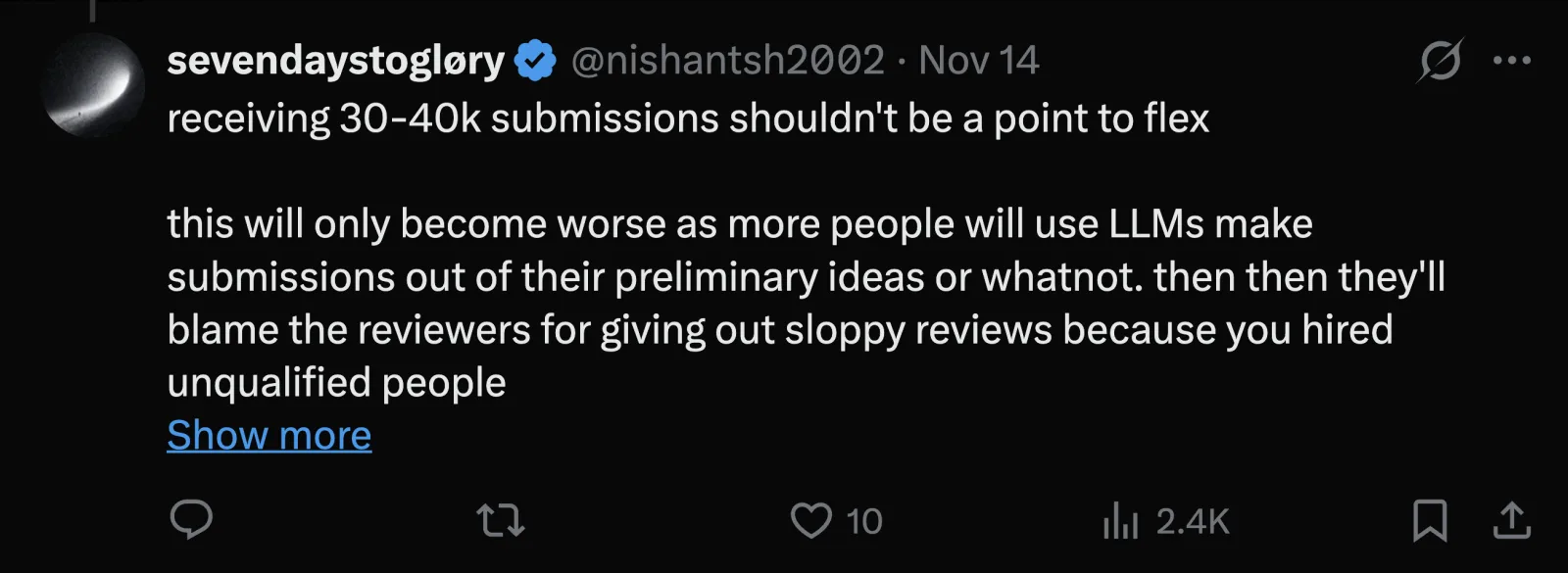
<p>It was November 2025, and I was burnt out from the ICLR review cycle. I kept seeing the same patterns across X. Authors felt the reviews were low effort, and reviewers felt they were drowning in lousy submissions. I was quick to diagnose this issue as stemming from relentless LLM usage and ranted on X (which wasn’t a particularly wise judgement looking back).</p>

<p><img loading="lazy" decoding="async" src="/assets/images/iclr_X.webp" alt="image" style="max-width: 70%; height: auto;" /></p>

<p>I frequently saw posts like this one. <a href="https://x.com/ry4335127356065/status/1994136778228592675?s=20">This was my first ICLR submission … and I must say that I’m not impressed. There may not be a second.</a></p>

<p>Or consider <a href="https://x.com/BlackHC/status/1989860379938238695?s=20">this infamous case</a> of a reviewer who always gave 40 verbose Weaknesses and Questions to all the papers they reviewed, then miraculously got convinced by the authors’ rebuttal and increased the score to 10, after they were flamed publicly and following the <a href="https://blog.iclr.cc/2025/12/03/iclr-2026-response-to-security-incident/">public information leak of OpenReview</a>. I could list hundreds of raging posts, or argue that conferences should allocate substantial screening resources before papers hit the reviewers. However, that would deviate from the goal of this blog. I am not trying to paint someone, or some technology, as the villain. I want to figure out what drives such experiences.</p>

<p>If someone reads this years later, they might wonder what the situation was in 2025. Here is the feeling many people share today: manuscripts look more polished than ever, but they feel harder to trust and understand. Reviews also started to feel generic, and default to “dutifully” highlighting missing baselines or incremental novelty. People blame LLMs for this slop, both on the authors’ side and the reviewers’ side. And sometimes they are right.</p>

<p>But the deeper issue existed even before LLMs. Every paper has a core idea, and then there are pages of text that try to make it feel like a proper paper. A lot of key details live outside these PDFs, in the author’s head, in private code repositories, in Slack messages, or in “we tried a bunch of stuff” that never really got recorded and made it to the final manuscript. The juicy part of research is often not even in the final 10-page PDF. It lives in unwritten context.</p>

<p>This is what this blog will be about: tacit knowledge, and the prosaic fluff that surrounds good ideas.</p>

<h3 id="why-2025-feels-like-the-tipping-point">Why 2025 feels like the tipping point?</h3>

<p>Why have LLMs pushed things over the edge? Simple. LLMs speed up everything, and that creates volume. Flaws become glaring flaws once there is enough volume.</p>

<p>LLMs help you code faster, which means you can run more experiments. Instead of setting up baseline comparisons, researchers can move on to the next idea for the next conference. LLMs also help generate decent sounding paper text really quickly. Not just editing or improving structure, but filling in the parts that make a paper sound like a paper: the introduction, related work, conclusion, and the experimental takeaways summarized. The contributions are already clear to the authors. LLMs generate the surrounding text to make it reviewer friendly, so the paper does not raise red flags or deviate too much from what a good paper is supposed to look like. Authors can then focus on the parts that feel more “core”, like the abstract, the method, and the results.</p>

<p>“Writing good papers is an essential survival skill of an academic (kind of like making fire for a caveman). In particular, it is very important to realize that papers are a specific thing: they look a certain way, they flow a certain way, they have a certain structure, language, and statistics that the other academics expect” — Karpathy mentioned in blog. He also recalls “being impressed with Fei-Fei (my adviser) once during a reviewing session. I had a stack of 4 papers I had reviewed over the last several hours and she picked them up, flipped through each one for 10 seconds, and said one of them was good and the other three bad”. That blog was written before the GPT era. What made a paper “look publishable” then is starting to lose its meaning now. Paper-like writing used to be a signal of effort, however weak it was. Now it is cheap. When it is cheap, it stops helping reviewers separate careful work from rushed work.</p>

<h3 id="the-pdf-problem-and-the-reproducibility-problem">The PDF problem and the Reproducibility problem</h3>

<p>I think two things are broken in ML publishing.</p>

<p>First, as discussed, is writing. The 10-page PDF has become ubiquitous. The real contribution is often small and sharp, but it gets wrapped in a lot of prose whose job is to look like a proper paper.</p>

<p>Second, I will talk about this in a bit, is reproducibility. Even when you understand the main idea, it can still be hard to reproduce the results. This becomes a real problem the moment you want to build on the work. (There seems to be some confusion between replication and reproducibility. <a href="https://rescience.github.io/faq">ReScience C</a> explains this distinction cleanly. Reproducibility means rerunning the same computation and getting the same result. Replication means independently re-implementing and still getting the claim)</p>

<p>These two problems connect. A lot of papers are not written to be self-sufficient. They assume the reader already knows the task setup, the assumptions, the data-cleaning choices, and the eval protocols. This is why I believe that stories are worth bringing up.</p>

<p><img loading="lazy" decoding="async" src="/assets/images/stories.webp" alt="stories" style="max-width: 100%; height: auto;" /></p>

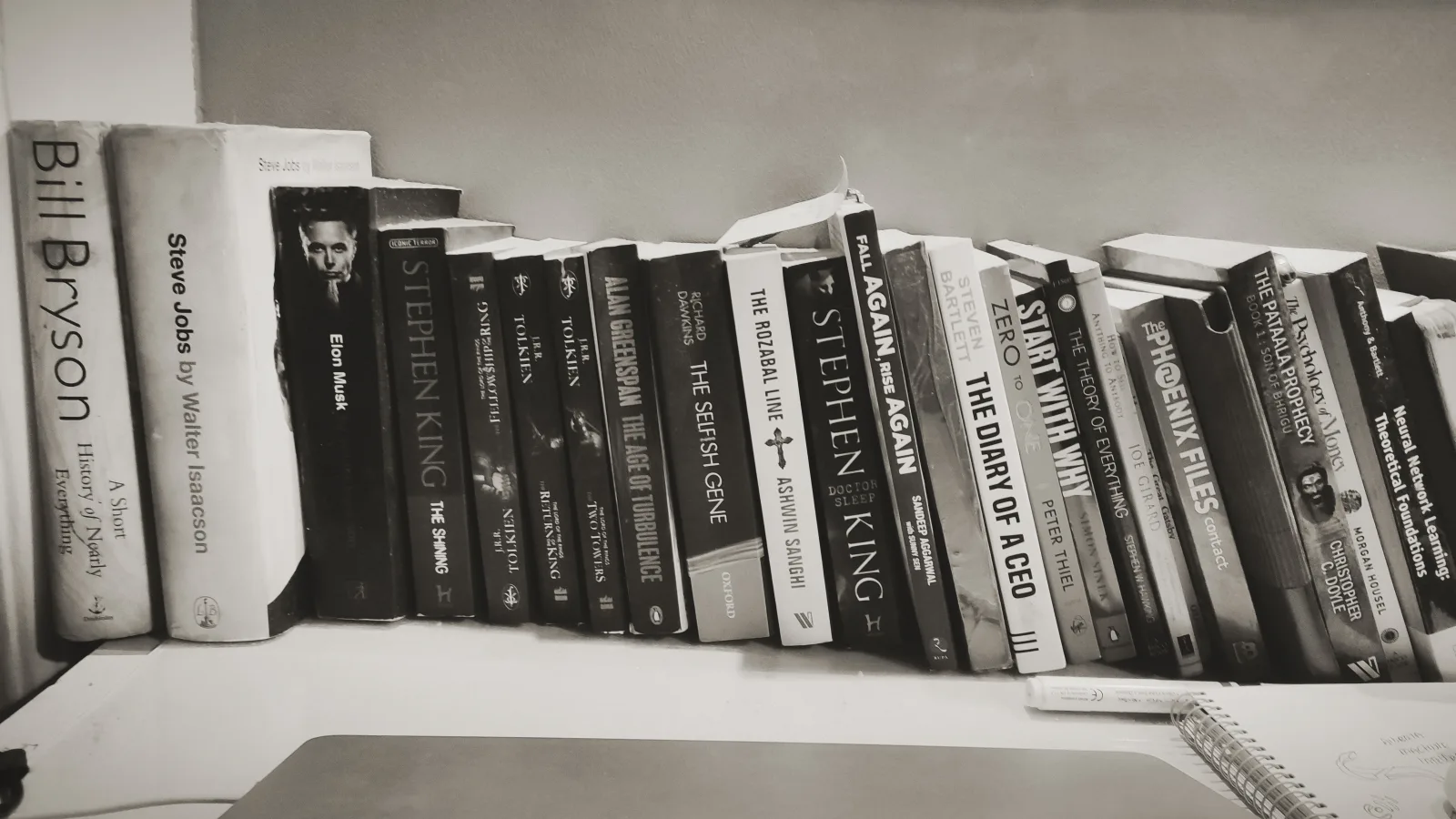
<p><em>Before you judge my lineup, this is just my desk setup, and my bookshelves at home are better, I promise.</em></p>

<p>Stories are not science, and they are certainly not rigorous, “suffering” from a wide gamut of interpretability. But they do one thing really really well: they are self-contained. You can start reading Lord of the Rings at page one. You do not need hidden context from the author to follow what is happening. There is no implied information, and that’s why anyone can start reading. That is why an 18-year-old and a 50-year-old can both read it, follow it, and even come up with what a sequel might look like. However, research papers often fail at this. The experienced reader can skim and still get it. The newer reader gets stuck because the paper assumes implied information and implicit steps.</p>

<p>After that, it is hard not to ask what a paper is supposed to do for a reader.I wonder what is the point of the present day 10-page PDFs if the new reader would anyway use ChatGPT to talk to that PDF and have a better understanding in 10 minutes than they were to get by hours of perusing? There are websites such as <a href="https://alphaxiv.org/">AlphaXiv</a> that help researchers cut through context clutter and get right into what a paper does and how it does that. If you feel like you lack background knowledge, you can even ask ChatGPT to produce a reading list to get you up to speed and that is something that I use a lot. Papers that become helpful in this category are mostly studies. They do not have to bear the weight of novelty or the prosaic necessities of a “good paper”. They are optimized for human reading. I also like JMLR and TMLR papers for this reason. Many readers already use chat tools to talk to PDFs anyway, and these tools will only get better. I would prefer more <a href="https://distill.pub/">distill</a> style writing and interactive formatting. So what is the 10-page PDF for, if it is not self-contained and hard to parse?</p>

<p>To be clear, I do not blame PhD researchers who are burdened by the need to publish. I want to understand what drives these practices. What are the incentives, spelled out, that push writing in the wrong direction?</p>

<h3 id="incentives-that-aggravate-the-pdf-problem-and-the-reproducibility-problem">Incentives that aggravate the PDF problem and the Reproducibility Problem</h3>

<p><em>Optimised for Peer Review</em> A paper is written for reviewers as much as for anyone else. Reviewers decide whether it gets accepted. MIT SLOAN’s study <a href="https://mitsloan.mit.edu/shared/ods/documents?PublicationDocumentID=10562">Does Peer Review Penalize Scientific Risk Taking?</a> found out that grants in the highest-risk decile are renewed at meaningfully lower rates than those in the lowest-risk decile. The risk penalty is larger for more novel work and for new and early-stage investigators, while the elites (National Academy members) face a smaller penalty. When evaluators have weaker priors about you or the area, they demand safer signals, which is our setting in double-blind peer review. (Granted that grant panels and peer reviewers are different, but the incentive is similar)</p>

<p><em>No reward for clarity</em> There is little direct reward for producing work that is optimized for human understanding, especially for humans of different backgrounds. Research is not organized like coursework. A lot of mental horsepower goes into inflating ideas into publishable hunks of 10-page PDFs.</p>

<p>I remember in my senior secondary, when I was preparing for my JEE exam, how well organized everything was. Mathematics, organic, inorganic, physical chemistry, and physics were packaged into coaching modules, test series, and notes that compressed two years of knowledge very well. All because of incentive. It was in the best interest of the publisher to organise text for maximal understanding, and have their pupil succeed in an exam of 1.5 million candidates and 1% selection rate.</p>

<p>You know what bothers me even more than unorganization? Unwarranted verbosity. People flexing a about the word count in their theses. Once again, as I’d like it to be known, the real problem is not just that papers have more content than necessary. It is that papers hide the information you need to trust them and build on them.</p>

<p><img loading="lazy" decoding="async" src="/assets/images/wordcount.webp" alt="wordcount" style="max-width: 60%; height: auto;" />
<em>A random post I found on X. Representative of what I am trying to convey with the above para.</em></p>

<p>On the bright side, I expect we will see this writing crisis abate soon. There is a funny side effect to LLMs democratising access to polished text. Papers have been written lousily and low-effort, polished text — just that with LLMs, anything with an iota of generic sounding BS gets accused of as GPT generated. When it gets so easy for everyone to cook up a word salad, and the ability to make one is no longer an indicator of articulation prowess or intellect, people realise this and revert back to using their own style. I’d like to believe that papers would receive the same treatment and improve.</p>

<p><img src="/assets/images/super.webp" alt="image" loading="lazy" decoding="async" /></p>

<p>We are, however, reaching another mountain which is more strenuous. Even the most powerful chatbots won’t be able to help if they cannot see how a paper came about its results!</p>

<p><em>Reproducibility is optional</em> While working on my own research experiments, I often get stuck trying to reproduce results. Responses from authors along the lines of “we used GPT 4 turbo for LLM-as-a-judge evaluations” and it so happens that OpenAI discontinued this model through its API so the past evaluations are of no good use. How convenient. Or “we used a second stage of reranking to get better results” which is nowhere to be seen in the manuscript or the source code but I luckily stumbled upon a GitHub issue that mentions how this is common practice with such methods. Really! Who would’ve guessed, right? More common are papers with incomplete or bug-ridden code, parts commented out, and undefined hyperparameters, or no code available whatsoever.</p>

<p>Tacit knowledge is often withheld to monopolize research. If you can prevent people from building on top of your work, while still having this work out there in public so colleagues appreciate your contributions, while you squeeze out publications on top of your past work, then congratulations! You’ve achieved what is now common practice. You see what is happening? This tacit information is becoming a moat. (I do acknowledge it is not always intentional)</p>

<p>Someone in a Hacker News article rightly pointed out that <b> academic papers are like publishing software into a blockchain </b> (not source but binaries, meaning PDFs full of shortcuts): you do not want people to easily find bugs and contribute fixes, so you handwave a lot so that no one can reproduce your exact thing.</p>

<p>The real bottleneck is not reading the PDF. It is everything the PDF cannot carry: the exact data path, the environment, the code, the seeds, et al. If we want papers to be trustworthy and buildable, the paper cannot just describe computation. To this end, I define the <b> unwritten half </b> of scientific research as the information that is not present in the paper but is required to build on top of it.</p>

<p>The hanging question is in figuring out how to publish that missing half. Following is the first thing I’ve seen that makes the unwritten half of scientific research publishable.</p>

<h3 id="neurolibre">NeuroLibre</h3>

<p><img src="/assets/images/neurolibre.webp" alt="image" loading="lazy" decoding="async" /></p>

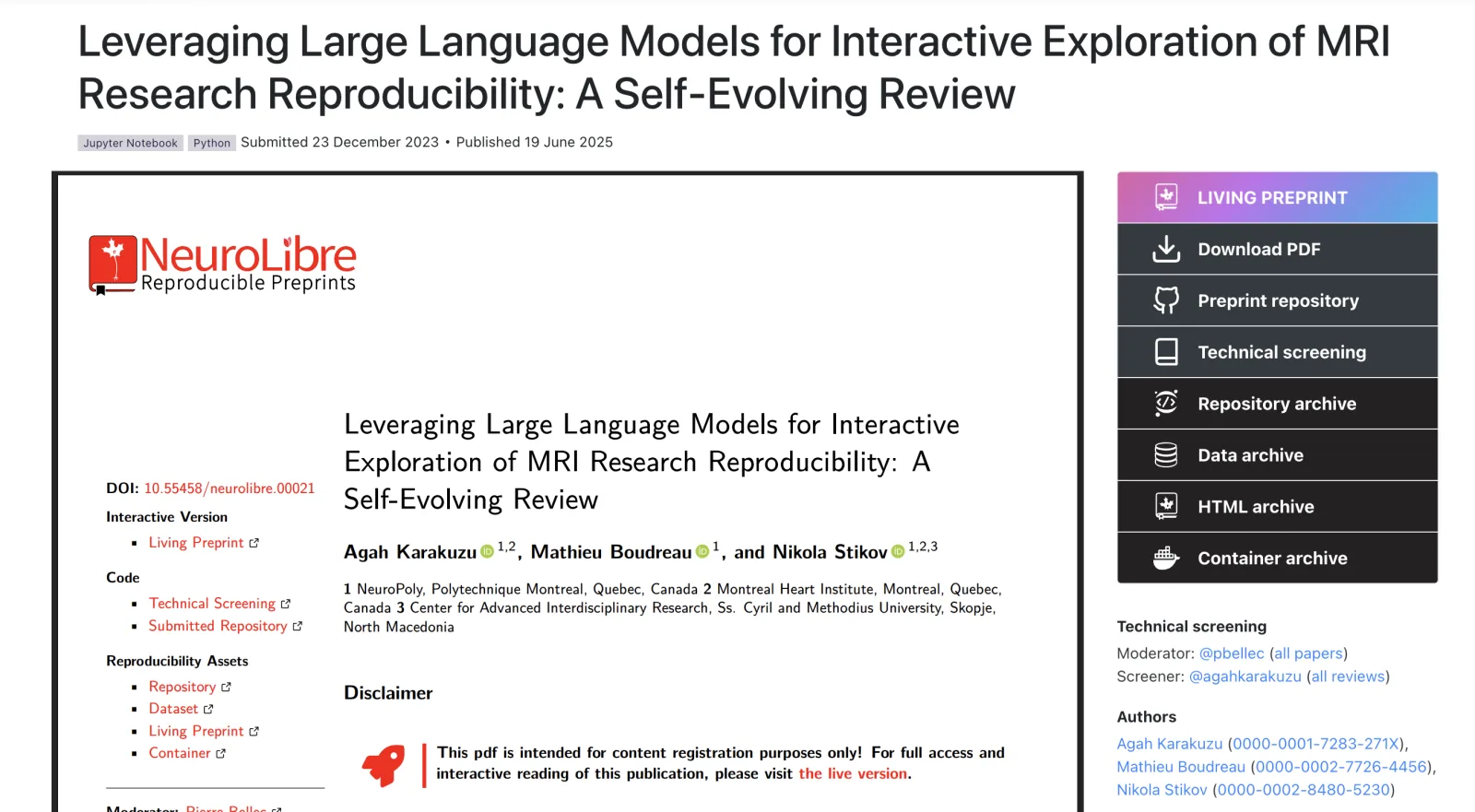
<p>What you see in this image is a living preprint. It looks like a paper, but it behaves like a runnable project. If you’re learning, you can it like a guided lab with jupyter books. If you’re reviewing, you can check claims easily without becoming tech support, because the publishing process has these checks built-in. If you’re building on top, you have all the resources you need here.</p>

<p>NeuroLibre is a preprint publishing platform for reproducible, executable research objects. Instead of treating the PDF or the TeX file as the main artifact, a NeuroLibre publication packages the paper with the its code, data, and a defined runtime so the work can be executed from a web browser. NeuroLibre describes these as “reproducible publications” and supports Jupyter notebooks that can be render as a living, interactive preprint.</p>

<p>A useful way to frame the real value of this platform is provenance. Instead of treating plots as just infographic images, the paper exposes where they come from and how they were produced. The goal is that results are traceable back to data and code, and executable end to end in the same environment thath the authors originally used.</p>

<p>NeuroLibre’s review process is primarily technical. Its mainly concerned on whether the resource builds and runs, and whether the reproducibility assets are present and usable, not on judging scientific novelty. NeuroLibre automates the build and reproducibility checks, but humans moderate submissions and run a technical screening process before anything is published.</p>

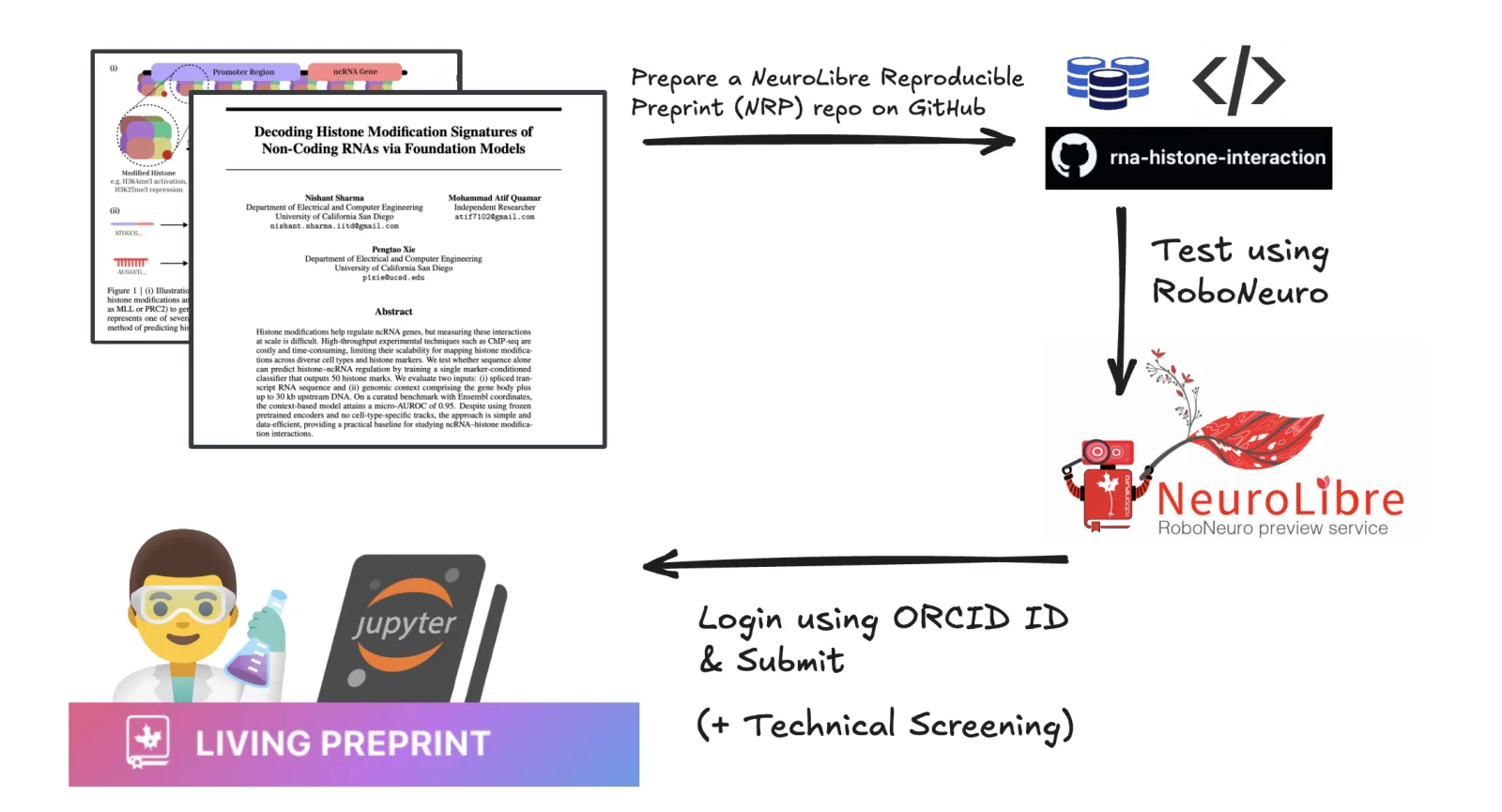
<p><img src="/assets/images/pipeline.webp" alt="image" loading="lazy" decoding="async" />
<em>Illustration of the whole process of putting your article on the platform.</em></p>

<p>“If only research outputs were more machine interpretable, searchable and discoverable then research could be incrementally automated and progress would go through the roof.” This is one of my favorite lines from the article <a href="https://www.neurolibre.org/blog/2025/06/26/the-business-of-extracting-knowledge-from-academic-publications/">The Business of Extracting Knowledge from Academic Publications</a>. The spirit of NeuroLibre is an embodiment of this idea. If we can make publishing on an open platform like fully frictionless for authors, we get much closer to truly complete papers.</p>

<hr />

<p>My position and all views, at the time of writing, come from the POV of a beginner in ML research. All views are my own and do not reflect the ideology of my affiliates.</p>

<p>Thanks to Dr. Nikola Stikov for motivating me to write this blog. I had the chance to speak with him and share his unconventional, potentially world-changing vision with you.</p>

<h3 id="bib">Bib</h3>

<ol>
  <li>Andrej Karpathy. <a href="https://karpathy.github.io/2016/09/07/phd/">A Survival Guide to a PhD</a></li>
  <li>ICLR 2026 Program Chairs. <a href="https://blog.iclr.cc/iclr-2026-response-to-security-incident/">ICLR 2026 Response to Security Incident</a>. ICLR Blog (Dec 3, 2025)</li>
  <li>ReScience C. <a href="https://rescience.github.io/faq/">FAQ: replication vs reproduction</a></li>
  <li>alphaXiv. <a href="https://alphaxiv.org/">Explore</a></li>
  <li>Distill. <a href="https://distill.pub/">Distill: Latest articles about machine learning</a></li>
  <li>Journal of Machine Learning Research (JMLR) (<a href="https://jmlr.org/">website</a>)</li>
  <li>Markus Strasser. <a href="https://markusstrasser.org/extracting-knowledge-from-literature#fundamental-issues-with-structuring-academic-literature-as-a-business">The Business of Extracting Knowledge from Academic Publications</a></li>
  <li>Hacker News discussion page for <a href="https://news.ycombinator.com/item?id=29481061">The Business of Extracting Knowledge from Academic Publications</a></li>
  <li>NeuroLibre. <a href="https://neurolibre.org/">project site</a></li>
  <li>Agah Karakuzu. <a href="https://doi.org/10.55458/neurolibre.00041">Toward a woven literature: Open-source infrastructure for reproducible publishing</a>. NeuroLibre (DOI: 10.55458/neurolibre.00041)</li>
  <li><a href="https://qantarot.substack.com/p/chatgpt-and-galactica-are-taking">ChatGPT and Galactica are taking scientific papers to their logical conclusion</a>.</li>
  <li>Interview. <a href="https://www.youtube.com/watch?v=OSpVDvAQbxE&amp;t=7s">Nikola Stikov on Open Science inspiration</a></li>
  <li>Does Peer Review Penalize Scientific Risk Taking? <a href="https://mitsloan.mit.edu/shared/ods/documents?PublicationDocumentID=10562">MIT Sloan Review</a></li>
</ol>]]></content><author><name></name></author><category term="blogs" /><summary type="html"><![CDATA[Modern ML papers are looking more polished than ever, yet feel hard to read and harder to build upon. This blog is about the unwritten half of scientific research: the tacit decisions and details that never make it into the PDF. At the end, I also point to what a better publishable artifact could look like.]]></summary><media:thumbnail xmlns:media="http://search.yahoo.com/mrss/" url="https://sevendaystoglory.github.io/assets/images/stories.webp" /><media:content medium="image" url="https://sevendaystoglory.github.io/assets/images/stories.webp" xmlns:media="http://search.yahoo.com/mrss/" /></entry><entry><title type="html">How are ANNs different from Biological Neurons</title><link href="https://sevendaystoglory.github.io/til/anns-snns/" rel="alternate" type="text/html" title="How are ANNs different from Biological Neurons" /><published>2025-02-01T00:00:00+00:00</published><updated>2025-02-01T00:00:00+00:00</updated><id>https://sevendaystoglory.github.io/til/anns-and-snns</id><content type="html" xml:base="https://sevendaystoglory.github.io/til/anns-snns/"><![CDATA[<p>Lately I have been reading about how neurons actually compute, and I kept wondering how the artificial neurons in our models compare to the real ones in our brains. So here is what I found about how biological neurons, regular artificial neural networks (ANNs) and spiking neural networks (SNNs) are alike, and mostly how they differ. It’s dense, I promise :)</p>

<hr />

<h2 id="how-do-biological-neurons-work-and-learn">How Do Biological Neurons Work. And Learn?</h2>

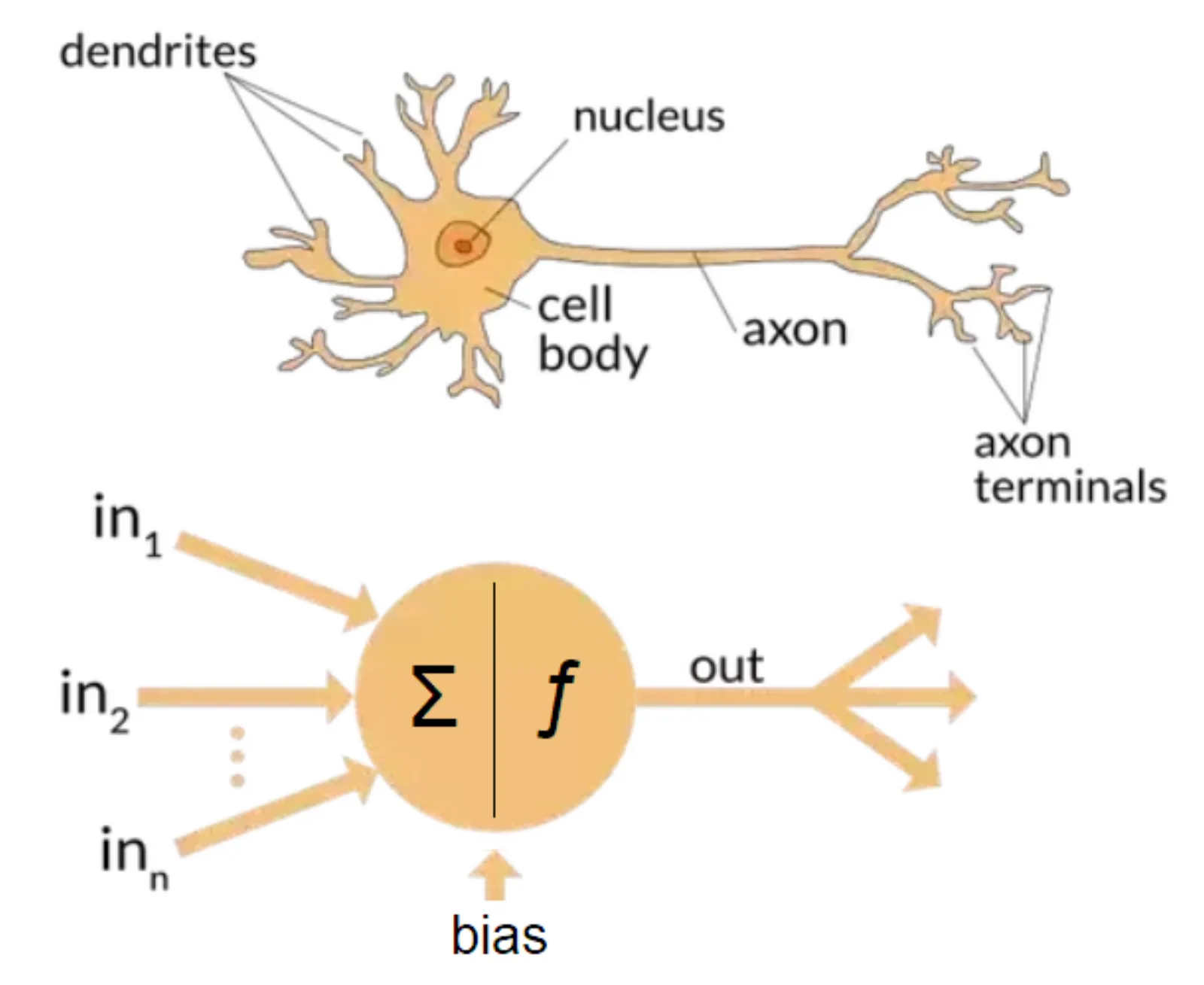
<p>Biological neurons are FAR more than simple binary switches. They are complex electrochemical devices that operate on both spatial(1) and temporal scales(2).</p>

<h3 id="the-core-mechanisms">The Core Mechanisms:</h3>
<ul>
  <li>
    <p><strong>Structure and Signal Integration:</strong><br />
Each neuron has a cell body (soma), dendrites, and an axon. Dendrites receive input signals -often chemical in nature - from other neurons, and the soma integrates these inputs. When the combined signal (or membrane potential) exceeds a threshold, an action potential is generated and travels down the axon.</p>
  </li>
  <li>
    <p><strong>Synaptic Transmission:</strong><br />
At the axon terminal, the electrical impulse triggers the release of neurotransmitters into the synaptic cleft. These chemicals bind to receptors on the adjacent neuron, either exciting or inhibiting it. The nature and strength of these synaptic connections are fundamental to how information flows through neural circuits.</p>
  </li>
  <li>
    <p><strong>Synaptic Plasticity and Learning:</strong><br />
Learning in the brain is largely a product of synaptic plasticity - the ability of synapses to change their strength. One prominent mechanism is Spike-Timing Dependent Plasticity (STDP), where the exact timing between the firing of a pre-synaptic neuron and a post-synaptic neuron determines whether a synapse is strengthened (potentiation) or weakened (depression). This precise timing is crucial; even millisecond differences can dictate the direction of synaptic change.</p>
  </li>
</ul>

<p>Put together, the wiring, the chemistry and the timing are what let the brain take in a lot of information and keep learning from what happens around it.</p>

<p><img loading="lazy" decoding="async" src="/assets/images/anns.webp" style="max-width: 60%; height: auto" /></p>

<h2 id="how-do-artificial-neural-networks-anns-work-and-learn">How Do Artificial Neural Networks (ANNs) Work. And Learn?</h2>

<p>Artificial Neural Networks, while inspired by biology, simplify these processes dramatically.</p>

<h3 id="architectural-overview">Architectural Overview:</h3>
<ul>
  <li>
    <p><strong>Mathematical Abstractions:</strong><br />
In ANNs, each “neuron” is a mathematical function that performs a weighted sum of its inputs, adds a bias, and then passes the result through an activation function (such as a sigmoid or ReLU). This abstraction takes away the temporal and chemical complexity of biological neurons. But gives us something that is rather easy to model!</p>
  </li>
  <li>
    <p><strong>Layered Structures:</strong><br />
Neurons are organized into layers - input, hidden, and output. The network learns to map inputs to outputs by adjusting the weights and biases through a process known as backpropagation.</p>
  </li>
</ul>

<h3 id="the-learning-process">The Learning Process:</h3>
<ul>
  <li>
    <p><strong>Backpropagation and Gradient Descent:</strong><br />
When an ANN makes a prediction, it calculates the error relative to the expected output. This error is then propagated back through the network, adjusting the weights using gradient descent. The algorithm minimizes the error over many iterations. While effective for many tasks, this method lacks the localized, time-sensitive adjustments seen in biological systems.</p>
  </li>
  <li>
    <p><strong>Static Versus Dynamic:</strong><br />
ANNs operate on static snapshots of data. They don’t naturally account for the timing of individual activations, which means they miss out on the temporal richness that biological neurons exploit for learning and memory.</p>
  </li>
</ul>

<p>ANNs have done amazing things in vision and language, but they leave out the timing and the chemistry that real neurons depend on.</p>

<hr />

<h2 id="a-better-emulation-spiking-neural-networks-snns">A Better Emulation: Spiking Neural Networks (SNNs)</h2>

<p><img loading="lazy" decoding="async" src="/assets/images/spikingneural.original.jpg" style="max-width: 60%; height: auto" /></p>

<p>Spiking Neural Networks attempt to bridge the gap between the highly abstracted world of ANNs and the messy, yet efficient, operations of biological brains.</p>

<h3 id="what-makes-snns-different">What Makes SNNs Different:</h3>
<ul>
  <li>
    <p><strong>Temporal Coding with Spikes:</strong><br />
Unlike ANNs, SNNs communicate using discrete spikes rather than continuous values. In these networks, the timing of each spike carries information, providing a natural way to encode temporal data..</p>
  </li>
  <li>
    <p><strong>Event-Driven Computation:</strong><br />
SNNs process information only when spikes occur. This event-driven approach mirrors the brain’s strategy, potentially reducing energy consumption and computational overhead - key advantages for neuromorphic hardware.</p>
  </li>
  <li>
    <p><strong>Incorporation of Biological Realism:</strong><br />
Models of SNNs include features like the refractory period (a brief period after a spike during which a neuron cannot fire again) and the dynamics of membrane potential. These elements add layers of realism that are completely absent in traditional ANNs.</p>
  </li>
</ul>

<p>SNNs are still an active area of research, but they represent a promising direction for making artificial systems that not only mimic the structure of biological brains but also emulate their dynamic behavior more faithfully.</p>

<hr />

<h2 id="benefits-of-snns">Benefits of SNNs</h2>

<p>There are several compelling advantages to pursuing spiking models over traditional ANNs:</p>

<ul>
  <li>
    <p><strong>Energy Efficiency:</strong><br />
Since SNNs compute only when necessary (i.e., on the occurrence of spikes), they naturally consume less energy. This is particularly beneficial for low-power applications and for hardware designed to mimic neural architectures.</p>
  </li>
  <li>
    <p><strong>Enhanced Temporal Processing:</strong><br />
The ability to process information based on spike timing allows SNNs to handle sequential and time-varying data more effectively. This is a significant edge in tasks like auditory processing, event-based vision, and robotics.</p>
  </li>
  <li>
    <p><strong>Closer Alignment with Biological Systems:</strong><br />
By incorporating elements such as STDP and refractory dynamics, SNNs offer insights into the biological processes of learning and adaptation. This not only enriches our understanding of the brain but may also lead to more robust and adaptable AI.</p>
  </li>
  <li>
    <p><strong>Potential for Unsupervised Learning:</strong><br />
Some SNN models can learn from unlabelled data through mechanisms akin to those used by the brain, potentially reducing the reliance on large, curated datasets required by supervised learning methods.</p>
  </li>
</ul>

<p>So SNNs might lead to AI that uses less energy and works more like the brain, and that could beat regular ANNs on tasks where timing and energy matter.</p>

<hr />

<h2 id="how-do-spiking-neural-networks-learn">How Do Spiking Neural Networks Learn?</h2>

<p>Learning in SNNs is an evolving field that combines principles from both neuroscience and machine learning.</p>

<h3 id="key-learning-mechanisms">Key Learning Mechanisms:</h3>
<ul>
  <li>
    <p><strong>Spike-Timing Dependent Plasticity (STDP):</strong><br />
Much like in biological systems, STDP in SNNs adjusts synaptic weights based on the precise timing between spikes. If a pre-synaptic neuron fires shortly before a post-synaptic neuron, the connection is strengthened; if the order is reversed, the connection weakens. This mechanism allows the network to self-organize based on the temporal structure of the input.</p>
  </li>
  <li>
    <p><strong>Surrogate Gradient Techniques:</strong><br />
One of the challenges with SNNs is that the spiking mechanism is non-differentiable, complicating the application of traditional backpropagation. Researchers have developed surrogate gradient methods that approximate the gradients during training, enabling SNNs to be optimized effectively while retaining their spiking behavior.</p>
  </li>
  <li>
    <p><strong>Hybrid Learning Approaches:</strong><br />
Some research attempts to combine backpropagation with local learning rules like STDP, aiming to harness the advantages of both global error minimization and local, time-dependent plasticity. This hybrid approach is still in its infancy but holds promise for training more complex spiking networks.</p>
  </li>
</ul>

<p>An in-depth discussion on these methods is available in recent studies, including a preprint on arXiv that delves into various algorithms and experimental results demonstrating the potential of SNNs in practical tasks.</p>

<hr />

<h2 id="final-thoughts">Final Thoughts</h2>

<p>Comparing the three matters for where AI goes next. ANNs have already changed a lot of fields, but they ignore timing and most of the biology, and that holds them back. SNNs care about when a spike happens, only do work when something happens, and stay closer to how the brain works, so they might be the next big step.</p>

<p>What I keep wondering is whether we can borrow the brain’s efficiency and its knack for adapting to build better machines. As these models improve, the line between biological and artificial computation may get blurrier, and I find that exciting.</p>

<p>If you have thoughts on SNNs, or on whether the messy, dynamic brain should shape the next generation of AI, I would love to hear them. My email is in the sidebar.</p>

<dl>
  <dt><em>Sources:</em></dt>
  <dd><a href="https://www.nature.com/articles/s41598-021-84813-6">Nature article on neuronal dynamics</a></dd>
  <dd><a href="https://arxiv.org/pdf/1804.08150">ArXiv preprint on spiking neural network learning</a></dd>
</dl>]]></content><author><name></name></author><category term="til" /><summary type="html"><![CDATA[Lately I have been reading about how neurons actually compute, and I kept wondering how the artificial neurons in our models compare to the real ones in our brains. So here is what I found about how biological neurons, regular artificial neural networks (ANNs) and spiking neural networks (SNNs) are alike, and mostly how they differ. It’s dense, I promise :)]]></summary><media:thumbnail xmlns:media="http://search.yahoo.com/mrss/" url="https://sevendaystoglory.github.io/assets/images/spikingneural.original.jpg" /><media:content medium="image" url="https://sevendaystoglory.github.io/assets/images/spikingneural.original.jpg" xmlns:media="http://search.yahoo.com/mrss/" /></entry><entry><title type="html">AI Cognition. And Emotions.❤️</title><link href="https://sevendaystoglory.github.io/project/ai-cognition/" rel="alternate" type="text/html" title="AI Cognition. And Emotions.❤️" /><published>2025-01-17T00:00:00+00:00</published><updated>2025-01-17T00:00:00+00:00</updated><id>https://sevendaystoglory.github.io/project/ai-companion</id><content type="html" xml:base="https://sevendaystoglory.github.io/project/ai-cognition/"><![CDATA[<p>This is what I tweeted on January 4.</p>

<blockquote class="twitter-tweet" data-dnt="true" style="max-width: 100%; margin: 0 auto;">
  <p lang="en" dir="ltr">
    <a href="https://twitter.com/nishantsh2002/status/1875351902738841797"></a>
  </p>
</blockquote>
<script async="" src="https://platform.twitter.com/widgets.js" charset="utf-8"></script>

<p>I wanted to develop an independent emotional entity that has its own desires. That can understand and reciprocate to human emotions.</p>

<p>What started in sometime in July 2023 as a routine mental masturbation exercise(1) went onto becoming a project(2) that finally gave rise to something meaningful in the form of a full fledged publically available application.(3)</p>

<h2 id="chapter-1-naive-exploration">Chapter 1: Naive Exploration.</h2>

<p>I had (then)recently watched the movie ‘Her’. An Ai powered OS, huh? Sounds interesting! But it was not its ability to organize emails, or to write poetry that made it so fascinating. We had GPT-3.5 then. It was very useful for a lot of things (mostly writing code, and drafting content) but was is not something that <b>you could just talk to</b>. It still not is! It is the idea of companionship that drew me in.</p>

<p><img loading="lazy" decoding="async" src="/assets/images/ai-cognition-notion.webp" style="max-width : 80%; height : auto" href="https://cake-action-ecf.notion.site/AI-cognition-and-Human-companion-eeb7677ef83b43ca817d1d31e1b7c322?pvs=74" />
<em><a href="https://cake-action-ecf.notion.site/AI-cognition-and-Human-companion-eeb7677ef83b43ca817d1d31e1b7c322?pvs=74">Here</a> is a documentation of things that I read.</em></p>

<h2 id="chapter-2-the-rise-of-a-bully-modelling-a-persons-thought-process">Chapter 2: The rise of a bully. Modelling a person’s thought process.</h2>

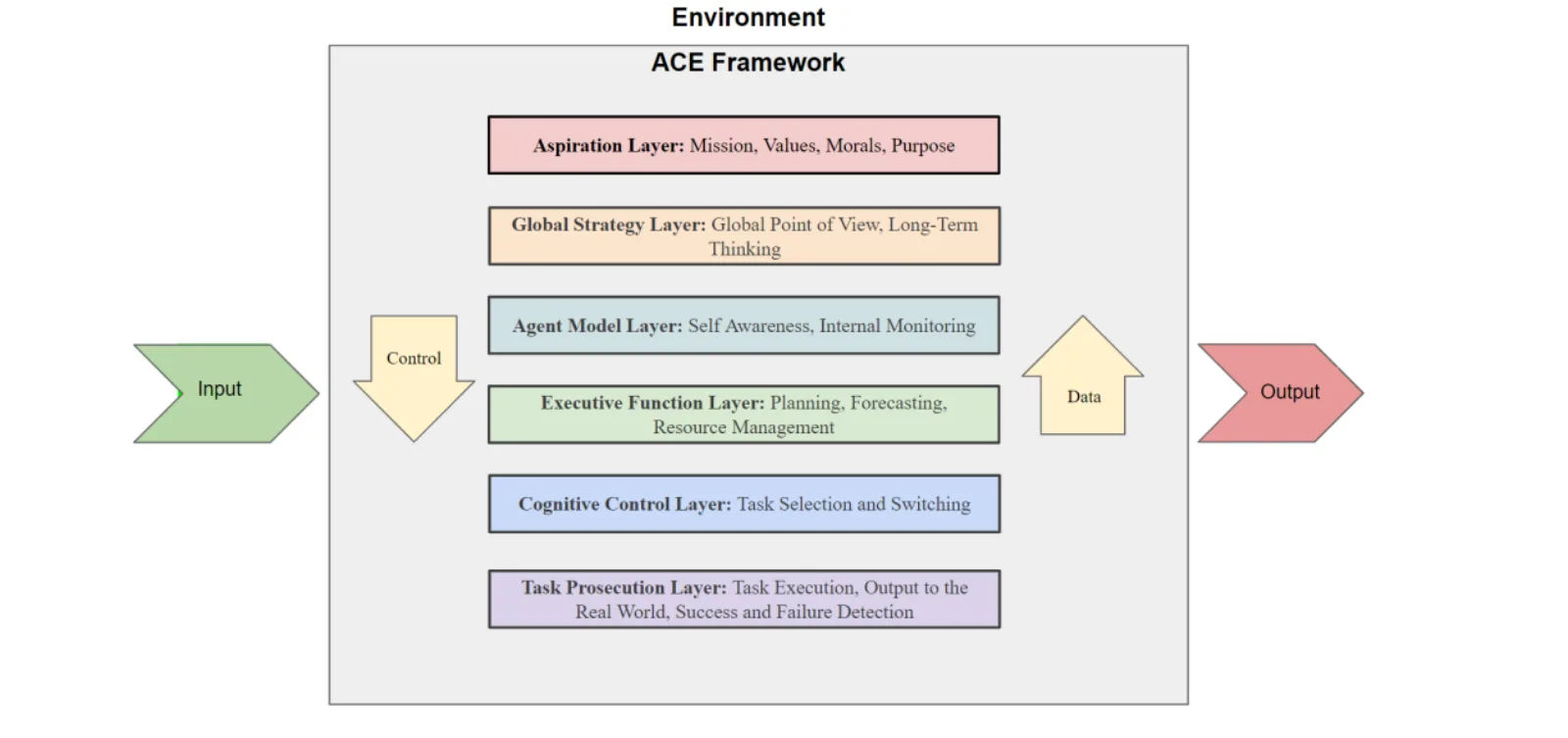
<p>I wanted some way in to this to tackle this problem statement. I’ve past experience from my research in the field of neuroscience. It came naturally to model the companion’s thought process as an <a href="https://arxiv.org/abs/2310.06775">ACE framework</a>, drawing inspiration from the OSI model.</p>

<p><img loading="lazy" decoding="async" src="/assets/images/ace-model.webp" style="max-width : 80%; height : auto" /></p>

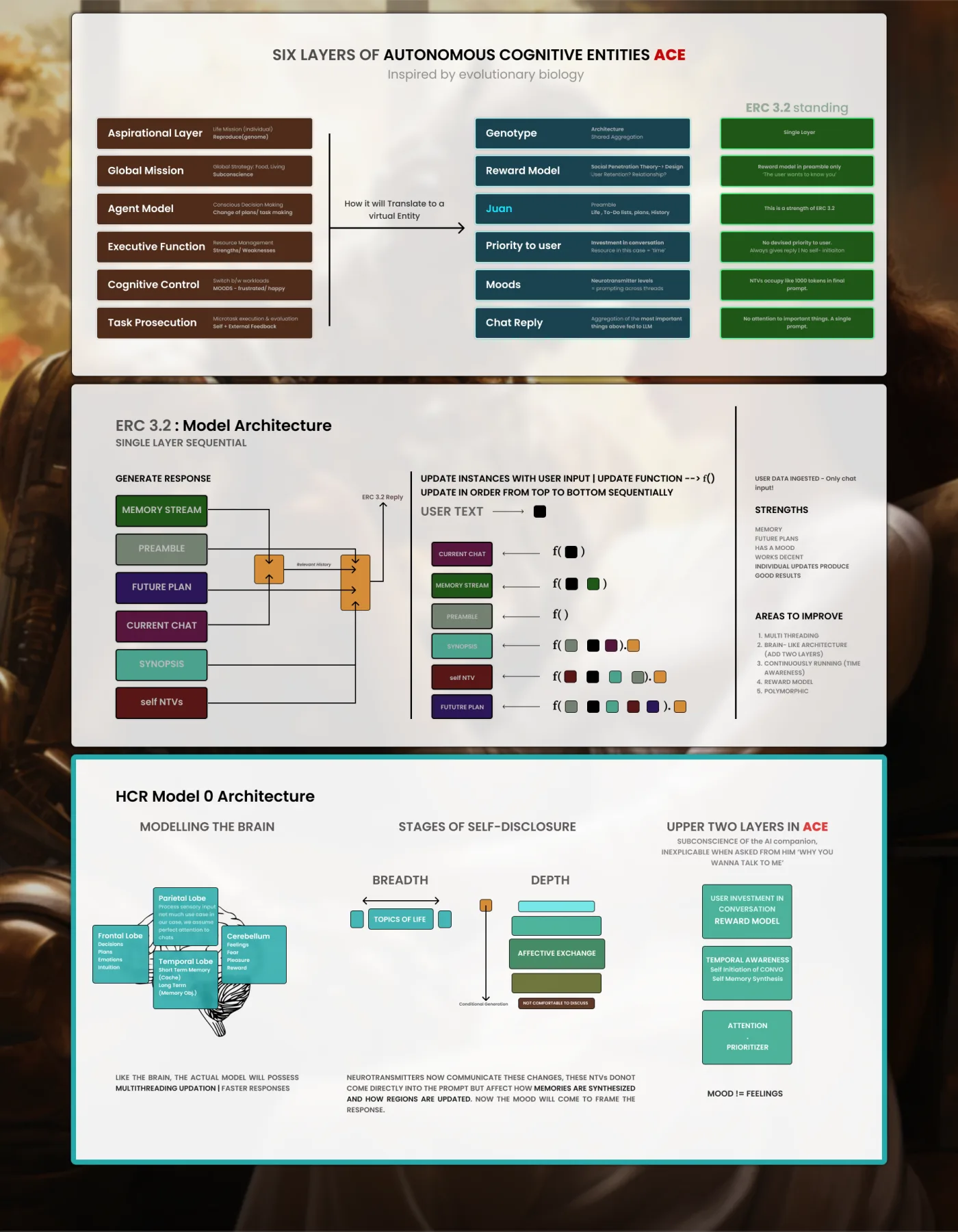
<h3 id="a-sneak-peak-into-my-architecture">A sneak peak into my architecture</h3>

<p><img loading="lazy" decoding="async" src="/assets/images/ERC-model.webp" style="max-width : 80%; height : auto" /></p>

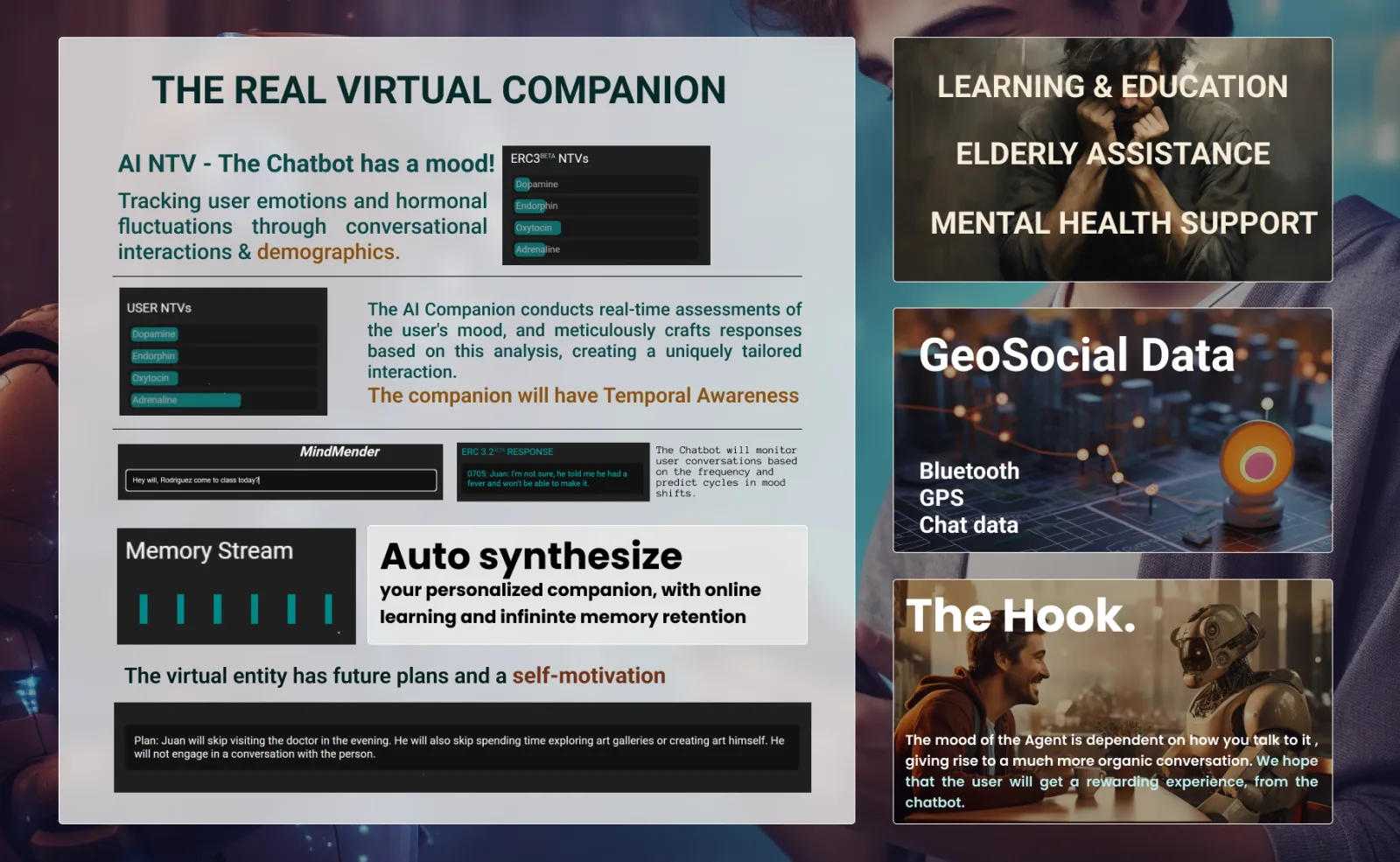
<h3 id="how-do-you-control-the-mood-a-chatbot-that-just-meekly-reciprocates-the-mood-is-boring-its-like-you-talking-to-you">How do you control the mood? A chatbot that just meekly reciprocates the mood is boring. Its like you talking to you.</h3>

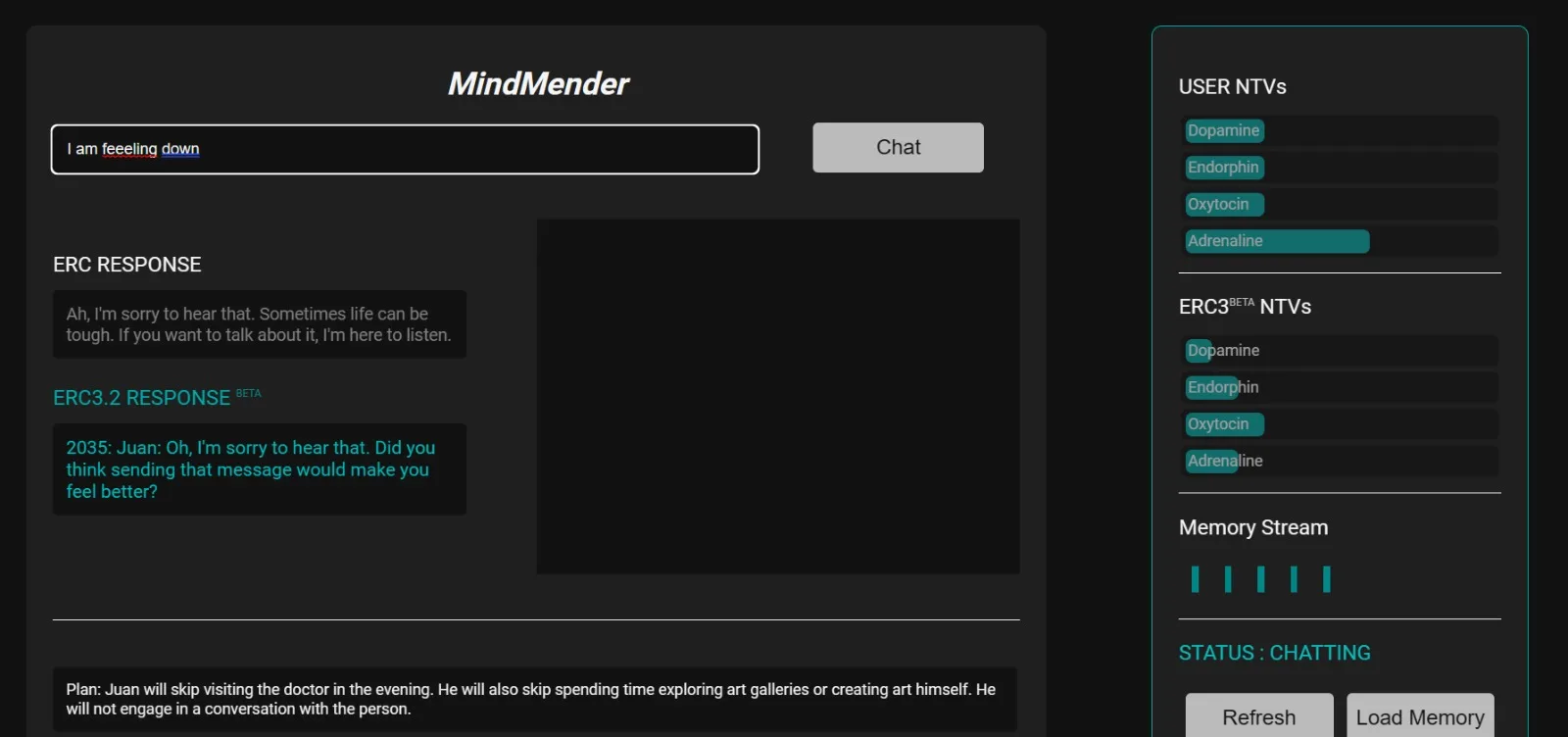
<p><img loading="lazy" decoding="async" src="/assets/images/mindmender.webp" style="max-width : 80%; height : auto" /></p>

<p>Words to self - The following should be checkmarked for the AI companion to come out as <strong>Reliable, Consistent, Intelligent, Empathetic, Intuitive, Proactive.</strong></p>

<h3 id="the-result-of-all-this">The Result of all this?</h3>

<p>All of my readings and implementations have produced very apparent differences in a legacy chatbot response and how an emotionally autonomus entity would respond.</p>

<p><img loading="lazy" decoding="async" src="/assets/images/difference.webp" style="max-width : 80%; height : auto" />
<em>An ERC response is the standard ‘Emotion Recognition in Conversation’ reply. The ERC 3.2 is the one with ACE framework implemented along with NTVs for mood.</em></p>

<h2 id="chapter-3-building-an-ai-buddy-for-mass-market">Chapter 3: Building an AI buddy for mass market!</h2>

<p>… How I built Nora.</p>

<p>This section is yet to be written.</p>]]></content><author><name></name></author><category term="projects" /><summary type="html"><![CDATA[An attempt at an emotionally autonomous AI companion: from reading notes to an ACE-style architecture for mood.]]></summary><media:thumbnail xmlns:media="http://search.yahoo.com/mrss/" url="https://sevendaystoglory.github.io/assets/images/mindmender.webp" /><media:content medium="image" url="https://sevendaystoglory.github.io/assets/images/mindmender.webp" xmlns:media="http://search.yahoo.com/mrss/" /></entry><entry><title type="html">Orbital Distances Visualizer</title><link href="https://sevendaystoglory.github.io/project/deep-impact/" rel="alternate" type="text/html" title="Orbital Distances Visualizer" /><published>2025-01-17T00:00:00+00:00</published><updated>2025-01-17T00:00:00+00:00</updated><id>https://sevendaystoglory.github.io/project/orbital-visualizer</id><content type="html" xml:base="https://sevendaystoglory.github.io/project/deep-impact/"><![CDATA[<p>So that’s how it started. On a boring weekend..</p>

<blockquote class="twitter-tweet" data-dnt="true" style="max-width: 100%; margin: 0 auto;">
  <p lang="en" dir="ltr">
    <a href="https://twitter.com/nishantsh2002/status/1880672505964429329"></a>
  </p>
</blockquote>
<script async="" src="https://platform.twitter.com/widgets.js" charset="utf-8"></script>

<p>This is an open-source tool born out of my obsession with memorizing distances in space. It’s a visualizer to help you get an intuitive feel for how far orbits and other space distances actually go.</p>

<p>Try it out <a href="https://sevendaystoglory.github.io/deep-impact">here!</a></p>

<video width="744" controls="" autoplay="" muted="" loop="" playsinline="" preload="metadata" style="max-width: 100%; height: auto;">
  <source src="/assets/videos/orbital-demo.mp4" type="video/mp4" />
  <img loading="lazy" decoding="async" src="/assets/images/deep-impact.webp" alt="Orbital Distances Visualizer Demo" style="max-width: 100%; height: auto;" />
</video>

<p>I’m documenting all the meaningful distances up to the orbit of the Moon. Think of it as a fun way to explore how far some of these orbits go, in a way that makes sense visually.</p>

<h3 id="how-to-run-it-locally">How to Run It Locally</h3>
<p>This is a simple React app, and getting started is super easy! Here’s what you need to do:</p>

<div class="language-bash highlighter-rouge"><div class="highlight"><pre class="highlight"><code>git clone https://github.com/sevendaystoglory/deep-impact
npm <span class="nb">install
</span>npm start
</code></pre></div></div>

<h3 id="how-you-can-contribute">How You Can Contribute</h3>
<p>This app is a work in progress, and I’d love for anyone to contribute! Here’s how you can help:</p>

<p>A. Add More Cool Distances Got interesting distances in mind? Add them to the app! Just make sure to include sources for any data you add in the data file.</p>

<p>B. Improve the UI The current UI is simple, but there’s room for so much more! Some ideas I’m thinking of implementig myself (and you can find more in the ideas file):</p>

<p>Temperature profile of the atmosphere Animations for asteroid sizes, speeds, and disintegration distances Any other useful or fun features that make exploring space distances more engaging. This project is built for learning and fun, so don’t hesitate to dive in. Let’s make exploring space distances intuitive and exciting for everyone!</p>

<p>Feel free to suggest improvements, report bugs, or share ideas.</p>]]></content><author><name></name></author><category term="projects" /><summary type="html"><![CDATA[An open-source visualizer for getting an intuitive feel for how far orbits and other distances in space actually go.]]></summary><media:thumbnail xmlns:media="http://search.yahoo.com/mrss/" url="https://sevendaystoglory.github.io/assets/images/deep-impact.webp" /><media:content medium="image" url="https://sevendaystoglory.github.io/assets/images/deep-impact.webp" xmlns:media="http://search.yahoo.com/mrss/" /></entry><entry><title type="html">How do you value a company?</title><link href="https://sevendaystoglory.github.io/til/company-valuation/" rel="alternate" type="text/html" title="How do you value a company?" /><published>2024-11-02T00:00:00+00:00</published><updated>2024-11-02T00:00:00+00:00</updated><id>https://sevendaystoglory.github.io/til/company-valuation</id><content type="html" xml:base="https://sevendaystoglory.github.io/til/company-valuation/"><![CDATA[<p>Valuing a company comes down to figuring out how much you’re willing to pay for it based on what it can earn in the future and what similar companies have sold for. Three common methods are:</p>

<ol>
  <li><strong>Discounted Cash Flow (DCF) Analysis</strong>
    <ul>
      <li>Estimate the company’s future cash flows (money it will earn).</li>
      <li>“Discount” those cash flows back to the present (using an interest rate that reflects risk).</li>
      <li>Sum them up to get today’s value of all those future earnings.</li>
    </ul>
  </li>
  <li><strong>Comparable Companies</strong>
    <ul>
      <li>Look at similar, publicly traded companies.</li>
      <li>Compare their share price to earnings (P/E ratio) or other multipliers.</li>
      <li>Apply those ratios to your company’s earnings to estimate its value.</li>
    </ul>
  </li>
  <li><strong>Precedent Transaction Analysis</strong>
    <ul>
      <li>Look at what other companies in the same space were bought for.</li>
      <li>Compare deal prices relative to their earnings or revenue.</li>
      <li>Use those benchmarks to figure out a fair price for your company.</li>
    </ul>
  </li>
</ol>

<p>Each method has its own strengths and weaknesses. In practice, investors often use a mix to get a clearer picture of what a fair deal looks like.</p>]]></content><author><name></name></author><category term="til" /><summary type="html"><![CDATA[Valuing a company comes down to figuring out how much you’re willing to pay for it based on what it can earn in the future and what similar companies have sold for. Three common methods are: Discounted Cash Flow (DCF) Analysis Estimate the company’s future cash flows (money it will earn). “Discount” those cash flows back to the present (using an interest rate that reflects risk). Sum them up to get today’s value of all those future earnings. Comparable Companies Look at similar, publicly traded companies. Compare their share price to earnings (P/E ratio) or other multipliers. Apply those ratios to your company’s earnings to estimate its value. Precedent Transaction Analysis Look at what other companies in the same space were bought for. Compare deal prices relative to their earnings or revenue. Use those benchmarks to figure out a fair price for your company. Each method has its own strengths and weaknesses. In practice, investors often use a mix to get a clearer picture of what a fair deal looks like.]]></summary></entry><entry><title type="html">What I Learned About Users and Product Features</title><link href="https://sevendaystoglory.github.io/blogs/learning-from-users-and-product-features/" rel="alternate" type="text/html" title="What I Learned About Users and Product Features" /><published>2024-10-16T00:00:00+00:00</published><updated>2024-10-16T00:00:00+00:00</updated><id>https://sevendaystoglory.github.io/blogs/product-and-users</id><content type="html" xml:base="https://sevendaystoglory.github.io/blogs/learning-from-users-and-product-features/"><![CDATA[<p>This is not an expert guide, and there are no hard rules in it. I just wrote down the things I learned about understanding users and deciding which features to build. By way of background, I work as a startup founder of a B2B enterprise platform.</p>

<p>Enjoy :)</p>

<h2 id="why-to-talk-to-your-users">Why to talk to your users?</h2>

<p>Why would you want to understand the user? A lot of people picture good ideas showing up on a lazy Sunday. In practice, the best founders keep learning from their users for as long as the company exists, and talking to users is what stops you from fooling yourself.</p>

<p>Founders like Deepinder Goyal choose to become a delivery person for a day to figure out anything that might be bugging delivery partners that hasn’t yet been addressed. Movies like The Social Network get this wrong. They never show the hours and hours spent going back and forth with users to get the product right. Brian Chesky, who founded Airbnb, spent a week with Amal—the very first guest at Airbnb. He also spent time in 50 different Airbnb locations, forming relationships and understanding the hosts because they are the ones making his product successful.</p>

<h2 id="whom-to-talk-to">Whom to Talk To?</h2>

<p>This aligns with my experience as a founder in the B2B enterprise space. Sales in this domain are extremely difficult, so each moment spent with a client is very important because feedback cycles are not common (unlike B2C) unless you are working directly with a client. Simply because:</p>

<p>It is very difficult to find a client.</p>

<p>People are paying way more at this scale for the product, so expectations are high—as it affects their work much more!</p>

<p>Now, this blog is not about sales, but this point was necessary to establish that enterprise users really do know a thing or two about the product and will directly let you know what features to add. Keep this in mind, especially if you are doing a pilot or paid POC with them (in which case the users are also your customers) —<u>you have to keep the product aligned to your end goal</u>. Don’t be very obstinate about the different features but focus on the goal.</p>

<p>Whom do you exactly reach out to?. Once I have figured out the demographic I want to target, this includes not only the list of companies I will cold email but also the relevant leaders within such organizations. Relevant people are further bucketed into individuals:</p>

<p>Who have the decision-making power for the organization, such as the director, VP, or CEO.</p>

<p>People who will be using the product, such as SDEs, sales reps, etc.</p>

<p>Better to start off talking to people you know—your coworkers from past companies or your past colleagues who’ve moved on to new companies. But they are the ones who are much more likely to tell you what you want to hear to not hurt your feelings.</p>

<h2 id="what-to-talk-about">What to talk about?</h2>

<p>What we want is for the product to be as good as possible for the people using it. So, do you ask the end user what feature they desire or give a list of features to them and have them choose which is the best one? Neither. <b>Users generally have good problems and bad solutions</b>. It is not their job to decide what product features will solve their problem—that is your job as a founder! Tell me - what incentive does your user have in telling you that they dislike this upcoming feature?</p>

<p>The customer will be best able to tell you about their problem and what they are currently doing to solve it. Some good questions that you can ask in the call are:</p>

<p>How are you currently doing X?</p>

<p>What is the hardest thing about doing X?</p>

<p>Why is it hard :)?</p>

<p>How often do you have to do X?</p>

<p>How much does it cost you to do X?</p>

<p>There are also a few things to avoid if you want to actually learn something from a call. And it does need to be a call, not an email:</p>

<p>Never, ever talk about your product or ask questions like, “How would a better product look to you?” This will bias the user.</p>

<p>Keep the interview (if I may call it so) about the user, not yourself. Many people, including me, fall for this initially and think that saying something clever about the problem will help the conversation. It usually doesn’t.</p>

<h2 id="how-to-talk">How to talk?</h2>

<p>This is the most important part of the post. If you get the chance, read The Mom Test. A lot of what I know about talking to users came from that book. They say you shouldn’t ask your mom whether your business is a good idea, because she loves you and will lie to you. This is technically true, but it misses the point.</p>

<p><b>You shouldn’t ask anyone if your business is a good idea. It’s a bad question, and everyone will lie to you at least a little.</b></p>

<p>As a matter of fact, it’s not their responsibility to tell you the truth. It’s your responsibility to find it, and it’s worth doing right.</p>

<p>The main idea is to frame questions to get honest feedback. Instead of asking, “Would you use this?” ask, “Can you tell me about the last time you faced this problem?” This helps avoid false positives, even from supportive people like your mom. Lots of entrepreneurs and founders will ask, “Would you use [description of their product]?” or “How much would you pay for [my product]?” But these questions aren’t helpful because no one wants to be the one to tell you that your baby is ugly, so they’ll be polite and say “Yes” and “$20” to make you feel good.</p>

<p>Instead, The Mom Test suggests that you focus your questions on learning about your target user’s workflow or daily habits related to your product’s topic, while being open to the fact that what you think was a terrible problem may just be a minor annoyance for your target user.</p>

<h2 id="pro-tip">Pro Tip</h2>

<p>Always make a list of questions that you want answered by the end of the conversation. Ask ChatGPT if these questions comply with The Mom Test rules. Then go on the call. It may not always happen that everything is clarified, but your job is to make the maximum out of the call, and not in an interrogative manner. I usually do this with the help of a Google Form and keep it to 4-5 calls a day for 10 days. No more.</p>

<p>Most of these lessons came back to me when I rewatched YC’s Startup School. They meant a lot more the second time, after I had made the mistakes myself.</p>]]></content><author><name></name></author><category term="blogs" /><summary type="html"><![CDATA[This is not an expert guide, and there are no hard rules in it. I just wrote down the things I learned about understanding users and deciding which features to build. By way of background, I work as a startup founder of a B2B enterprise platform.]]></summary></entry><entry><title type="html">World’s Largest Data Storage System - S3</title><link href="https://sevendaystoglory.github.io/til/worlds-largest-data-storage-system-s3/" rel="alternate" type="text/html" title="World’s Largest Data Storage System - S3" /><published>2024-09-29T00:00:00+00:00</published><updated>2024-09-29T00:00:00+00:00</updated><id>https://sevendaystoglory.github.io/til/aws-s3</id><content type="html" xml:base="https://sevendaystoglory.github.io/til/worlds-largest-data-storage-system-s3/"><![CDATA[<p><strong><a href="https://www.allthingsdistributed.com/2023/07/building-and-operating-a-pretty-big-storage-system.html">Source: How AWS Simple Storage Service (S3) Works</a></strong></p>

<p>Amazon S3 is a massive object storage service with an HTTP REST API. Under the hood, it has several key parts:</p>
<ul>
  <li>A fleet of web servers handling incoming client requests</li>
  <li>A global namespace service (tracking object locations)</li>
  <li>A huge storage fleet (HDDs and some SSDs)</li>
  <li>A background operations fleet (managing maintenance tasks)</li>
</ul>

<h2 id="the-magic-of-hdds">The Magic of HDDs</h2>
<p>S3 still uses many mechanical hard drives because they’re good for <strong>sequential I/O</strong> and cheaper than SSDs for bulk storage. Here’s a wild fact about modern HDD precision:</p>

<hr />

<blockquote>
  <p><em>Imagine a Boeing 747 flying 75 mph over a large field of grass. The gap between the plane and the grass would be about two sheets of paper, and the “track width” on the spinning disk is only about 4.6 blades of grass wide. These drives miss reading a blade of grass about once every 25,000 times that plane circles the earth!</em></p>
</blockquote>

<hr />

<p>That kind of precision lets HDDs reach a data density of about 15 GB/cm². But they have a big limitation: random access is slow because the drive head has to physically move. An HDD might only do ~120 random I/O operations per second, which severely limits random access at large scale.</p>

<h2 id="scale-and-heat-management">Scale and Heat Management</h2>
<p>S3 uses the largest HDDs available (26 TB or more) and deals with <strong>heat management</strong>, i.e., avoiding hotspots. Hotspots happen when a few drives get overloaded, causing slow performance. The challenge is <strong>we don’t know future access patterns at the time data is written</strong>, yet we have to decide how to place that data.</p>

<p>A key solution is that:</p>
<ul>
  <li><strong>Aggregate demand</strong> (from millions of customers) becomes more predictable overall.</li>
  <li>S3 spreads and replicates data widely so individual disks only see a small fraction of a single customer’s workload.</li>
</ul>

<h2 id="redundancy-at-scale">Redundancy at Scale</h2>
<ol>
  <li><strong>Replication</strong> – Storing multiple copies (mirroring) of data across disks for both durability and performance.</li>
  <li><strong>Erasure Coding</strong> – Achieves better storage efficiency than full replication by splitting data into chunks and storing them with parity blocks. This protects against data loss without paying for 100% or 200% overhead.</li>
</ol>

<video width="744" controls="" autoplay="" muted="" loop="" playsinline="" preload="metadata" style="max-width: 100%; height: auto;">
  <source src="/assets/videos/fast-agg-graph-compressed-small.mp4" type="video/mp4" />
  <img loading="lazy" decoding="async" src="/assets/images/burst.webp" style="max-width: 60%; height: auto;" />
</video>

<p>By spreading objects across many disks, each customer can burst to huge I/O rates. Even with each disk limited to ~120 IOPS, having thousands of disks in parallel can handle massive workloads that would be impossible on a single, smaller system.</p>]]></content><author><name></name></author><category term="til" /><summary type="html"><![CDATA[Source: How AWS Simple Storage Service (S3) Works]]></summary><media:thumbnail xmlns:media="http://search.yahoo.com/mrss/" url="https://sevendaystoglory.github.io/assets/images/burst.webp" /><media:content medium="image" url="https://sevendaystoglory.github.io/assets/images/burst.webp" xmlns:media="http://search.yahoo.com/mrss/" /></entry><entry><title type="html">How Many Humans are Possible?</title><link href="https://sevendaystoglory.github.io/blogs/how-many-humans-are-possible/" rel="alternate" type="text/html" title="How Many Humans are Possible?" /><published>2024-03-28T00:00:00+00:00</published><updated>2024-03-28T00:00:00+00:00</updated><id>https://sevendaystoglory.github.io/blogs/how-many-humans-are-possible</id><content type="html" xml:base="https://sevendaystoglory.github.io/blogs/how-many-humans-are-possible/"><![CDATA[<p>In this blog, I’ll explore the intriguing questions: How many humans have lived on Earth, and how many will there ever be?</p>

<p><img loading="lazy" decoding="async" src="/assets/images/many-people.webp" alt="Many Humans" width="744" style="max-width: 100%; height: auto;" /></p>

<p>Before diving in, I want to clarify some assumptions. We’re <b>NOT</b> counting variations in brain or body state as criteria for defining a distinct human being.</p>

<p>You remain fundamentally the same person, whether before or after losing an arm, or even embarking on a journey of self-enlightenment. Similarly, our analysis does not account for the various ancestral human species. More than 4 billion years ago, our Last Universal Common Ancestor (LUCA) emerged as a single cell. This cell’s descendants multiplied and evolved, leading to the emergence of Homo Erectus, then Neanderthals, and eventually Homo Sapiens.</p>

<p>One could argue that Neanderthals and Sapiens coexisted, but let’s not focus our attention on our hairy ancestors. We want to make as much variations in Homo Sapiens as possible. Lets choose a good indicator of variation. Since a body can be tarnished and the mind evolve over lifetime. I choose the DNA🧬. Over 3 billion base pairs exist and much of it doesn’t change through the lifetime of the individual.</p>

<p>Acquired (or somatic) mutations occur at some time during a person’s life and are present only in certain cells, not in every cell in the body. Hereditary mutations are inherited from a parent and are present throughout a person’s life in virtually every cell in the body.</p>

<p>Lets us, for now focus on the variation that is present by birth. We are now talking about how many different human embryos are possible. Which is a rather nice way to put it. All our features and differences are an emergent property of the sheer number of individual cells. A single DNA strand, in fact, in each cell may not be very different across 2 humans.</p>

<p>It begs the question - how much changes a DNA can tolerate before a person loses his ability to interbreed with other humans? Well, our cousins the chimpanzees are somewhere close to that. I think the evidence is pretty strong that humans and chimps cannot interbreed. At the DNA level, we share 99.9% of DNA with each other, 99% with chimpanzees , our closest relatives. However, these numbers only reflect point mutations. This is after a separation of 6–8 million years.</p>

<p><b>Fact - You share 50% of our DNA with a banana.</b>
I recommend you <a href="https://lab.dessimoz.org/blog/2020/12/08/human-banana-orthologs">read more</a> on where did the mythical 50% come from anyway.</p>

<p><img loading="lazy" decoding="async" src="/assets/images/banana-meme.jpg" alt="Banana Meme" width="558" style="max-width: 100%; height: auto;" /></p>

<p>What do we have common with a banana?</p>

<p>Primarily in the genes responsible for basic cellular functions like DNA replication, cell cycle control, and cell division. This genetic similarity is more pronounced in the protein-coding genes, where the overlap accounts for the commonly cited statistic that humans and bananas share around 50% of their DNA. Let it be known that -</p>

<p>Organic matter on earth has evolved to thrive and multiply, and basically that information is encoded in the bulk of the DNA. It details how to utilize environmental resources, process organic molecules, and convert sunlight into the energy that fuels life. This shared genetic code reveals the interconnectedness of life, rooted in universal strategies for survival</p>

<p>Our genome has 3 billion base pairs so a naive calculation shows 3x10^36 different combinations. But that’s a meaningless number. A lot of those variants would be silent mutations.
A lot of changes would be lethal, rendering us dead at some stage of development because of a lack of a crucial component.
This brings light to a fact that much of the DNA is made up for functional purposes, such as synthesizing proteins for basic bodily functions, growth.</p>

<p>A more interesting (if harder-to-define) question might be how many different traits can be embodied in human DNA. After all, most human DNA has little or no function, so mutations in these low-information sequences are inconsequential.
<a href="https://qr.ae/ps2pc3">I sourced from Drew Smith</a>.</p>

<p>The universe of genes that are actually expressed in humans - called the exome - is comprised of about 30 million bases of DNA. Sequence changes in this DNA are more likely to lead to an actual change in the functioning of genes and their expressed products.</p>

<p><a href="http://science.sciencemag.org/content/337/6090/64">One effort to quantify exome variability</a> estimates that each human carries about 13,500 variants, and that perhaps 300 of these affect gene function. Again, you can multiply this number out by the number of persons now living (7 billion), or the number that have ever lived (<a href="http://www.prb.org/Publications/Articles/2002/HowManyPeopleHaveEverLivedonEarth.aspx">108 billion</a>) to get another very large number. But that is the lower limit. The number of possible combinations is 1 x 2 x 3 … x 300 = 300! = 3 x 10^614, a number that is so large as to be meaningless.</p>

<p>Among the various details in this blog, one standout fact is that the potential number of unique human beings is represented by a figure followed by 614 zeroes. Even if we populated every planet in the observable universe with the number of people who have ever lived on Earth, we would still be unlikely to find any two individuals who are exactly alike.</p>]]></content><author><name></name></author><category term="blogs" /><summary type="html"><![CDATA[In this blog, I’ll explore the intriguing questions: How many humans have lived on Earth, and how many will there ever be?]]></summary><media:thumbnail xmlns:media="http://search.yahoo.com/mrss/" url="https://sevendaystoglory.github.io/assets/images/many-people.webp" /><media:content medium="image" url="https://sevendaystoglory.github.io/assets/images/many-people.webp" xmlns:media="http://search.yahoo.com/mrss/" /></entry><entry><title type="html">Bending People’s Perception to Your Will</title><link href="https://sevendaystoglory.github.io/blogs/bending-perception/" rel="alternate" type="text/html" title="Bending People’s Perception to Your Will" /><published>2024-03-11T00:00:00+00:00</published><updated>2024-03-11T00:00:00+00:00</updated><id>https://sevendaystoglory.github.io/blogs/bending-perception</id><content type="html" xml:base="https://sevendaystoglory.github.io/blogs/bending-perception/"><![CDATA[<p><img loading="lazy" decoding="async" src="/assets/images/caesar.webp" alt="Caesar in Stone" width="558" style="max-width: 100%; height: auto;" /></p>

<p>Yes, that is a Twitter hashtag carved into old stone, about how Julius Caesar died. It looks like a joke. But think about what would have happened if that history had played out on the internet, where a radical idea in an unstable time could reach everyone at once.</p>

<p>Today almost anyone can use technology to change what a lot of people think, and that is enough to swing elections and change how a society works. You can spread hate, write propaganda aimed at exactly the right people, or build an army of fake accounts that repeat whatever you say. There is a lot of room to misuse it.</p>

<p>Imagine Julius Caesar today, fighting his battles on social media. “The die is cast,” he posts, and this time it’s a tweet that goes viral instead of an army crossing the Rubicon (ref. Caesar Crosses the Rubicon). Then one provocative idea spreads across the internet: “What if we ruled ourselves?” Soon Rome’s streets are empty. Caesar’s empire, which looked so solid, starts to fall apart. What brings it down is not (et tu? :) Brute force. It is people whose minds were turned by a good story, told by someone charismatic online. Narrative is not so hard to artificially construct and validate. Charisma, well, is factor of a time gone by since much of ideas these days spread via our digital social networks.</p>

<p>The saying “the pen is mightier than the sword” has always meant a lot because historians could shape how we see rulers, sometimes by their own choice or by orders. But today, being a thought leader is even more powerful.</p>

<p>Technology can do a lot of good too. It can make learning more fun, show us what life was like in the past, or keep us company when we feel lonely. So the question I keep coming back to is how we make sure these tools are used well, and how we avoid being pushed around by algorithms and propaganda without even noticing.</p>

<p>–</p>

<p><img loading="lazy" decoding="async" src="/assets/images/generative-agents.webp" alt="Generative Agents" width="558" style="max-width: 100%; height: auto;" /></p>

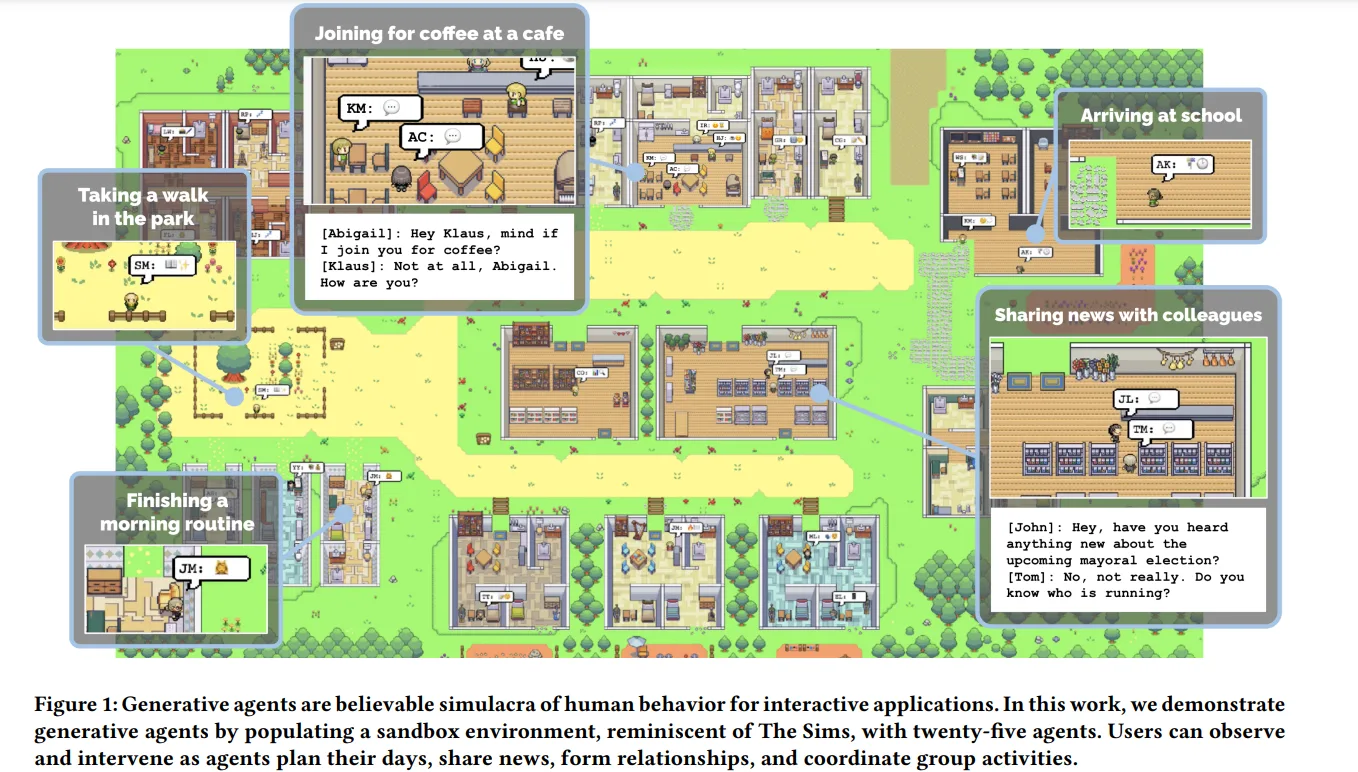
<p>Generative Agents: Interactive Simulacra of Human Behavior came out as a research paper in Human Computer Interaction (HCI). The paper introduces generative agents designed to simulate believable human behavior for various interactive applications. The agents can remember what happened to them, think back on it, talk to each other and make plans as things change around them. The paper gives three things: the agents themselves, a memory system that keeps each agent consistent over a long time, and a small town like The Sims where you can watch them live. Here, Joon Sung, one of the first authors from Stanford, explains the paper in detail. I recommend watching it. The design is much simpler than you would expect, and that’s what makes it beautiful.</p>

<p>They’ve developed digital characters, known as “generative agents,” that mimic human behavior in a surprisingly realistic way. These agents go about their daily lives, engaging in activities from cooking breakfast to heading off to work. Each one has its own memory, so it can remember what happened before and use that to decide what to do next.</p>

<p>Set in a virtual town of The Sims, users can interact with these agents, witnessing their ability to form relationships, plan events, and even remember past interactions. A standout example is how these agents autonomously organized a Valentine’s Day party, inviting others and coordinating their attendance without any external prompts. (This emergent property of a swarm of agents is very fascinating to me!)</p>

<p>What I found more important is that the paper also talks about what could go wrong when agents like these are let loose in real systems.</p>

<p>Imagine these smart digital characters, or agents, getting trained on a subreddit. They’re designed to be charming and dodge any trouble, engaging the community to help it flourish until self-sustaining chat discussions naturally keep flowing. The worrying part is that the same agents could go into other communities and start fights on purpose. They would bring up topics that upset people, and slowly make the place worse from the inside.</p>

<p>It’s like planting a super charismatic person in a club who knows exactly what to say to make the place more popular. But then, they start visiting other clubs, spreading rumors or picking fights, ruining the vibe everywhere they go. This doesn’t happen in real life because people risk their own image. A bot has no reputation to protect, so nothing holds it back. Now picture millions of them all working toward one goal, bringing down a Caesar. That is something to watch for in the 2024 elections.</p>]]></content><author><name></name></author><category term="blogs" /><summary type="html"><![CDATA[]]></summary><media:thumbnail xmlns:media="http://search.yahoo.com/mrss/" url="https://sevendaystoglory.github.io/assets/images/caesar.webp" /><media:content medium="image" url="https://sevendaystoglory.github.io/assets/images/caesar.webp" xmlns:media="http://search.yahoo.com/mrss/" /></entry><entry><title type="html">The War between Creators and Proclaimers</title><link href="https://sevendaystoglory.github.io/blogs/the-war-between-creators-and-proclaimers/" rel="alternate" type="text/html" title="The War between Creators and Proclaimers" /><published>2024-02-16T00:00:00+00:00</published><updated>2024-02-16T00:00:00+00:00</updated><id>https://sevendaystoglory.github.io/blogs/war-between-creators-and-proclaimers</id><content type="html" xml:base="https://sevendaystoglory.github.io/blogs/the-war-between-creators-and-proclaimers/"><![CDATA[<blockquote>
  <p>The society that separates its scholars from its warriors will have its thinking done by cowards and its fighting by fools.</p>

  <p><em>~Thucydides</em></p>
</blockquote>

<p><img loading="lazy" decoding="async" src="/assets/images/jayce-viktor.webp" alt="Viktor and Jayce from Arcane" width="558" style="max-width: 100%; height: auto;" /></p>

<p><em>Viktor (left) and Jayce (right) from the series Arcane</em></p>

<p>Most of us have met two kinds of people. One thinks a problem through for a long time before doing anything, and the other acts first and works out the details later. If you have spent enough time around either kind, you may have grown to really dislike them. Viktor and Jayce in the picture above (from my favorite animated series, Arcane) are a good pair to keep in mind for the rest of this post. Viktor is the one who dares to think, and Jayce is the one who dares to act. You can see the same split in a classroom, where the careful, nervous kid does all the work on a group project and the loud one stands up and presents it as their own, and it carries on in much the same way once those kids grow up and go to work.</p>

<p>If you have worked at an AI company, you have probably seen a small version of this. Some people spend their days writing code, and others spend theirs talking to customers and investors. The two groups need each other, and that has been true for a very long time.</p>

<p>In the 1970s, Xerox’s research lab in Palo Alto built a computer called the Alto, and it was years ahead of anything else around. It had ideas that would later become standard in personal computers. However, Xerox, primarily known for its photocopying technologies, failed to fully recognize the potential of the Alto and the groundbreaking work being done at Palo Alto Research Center (PARC). The company was not sure it wanted to sell personal computers, so it held back. You could call that playing it safe, or you could call it cowardice.</p>

<p>While Xerox did introduce some of the technologies developed at PARC into its products, it was Apple Computer that truly capitalized on these innovations. Steve Jobs visited Xerox PARC in 1979, and the visit famously inspired elements of the Apple Lisa and, more significantly, the Macintosh. Apple was not hindered by the same level of caution that constrained Xerox and aggressively pursued the development and marketing of personal computers with GUIs, effectively bringing to the mass market the revolutionary concepts that Xerox had developed.</p>

<p>Jobs, not a fool by any standards, performed a clean sweep of the market from his coward counterpart.</p>

<p>I have no intent to antagonize the proclaimers, as they are the bearers of the consequences as much as they are the reapers of fruit of creation. I think a creation only starts to matter once someone takes responsibility for it and puts it in front of people. Until then it does not really change anything. We’ll consider ‘humanity’ on the same level as ‘society’, recognizing that it’s humanity’s prerogative to determine the relevance of any creation within the broader context. The same way a startup is but a twig in the maelstrom of the market response. The creator may build the ship, but to sail it only an expert helmsman can. Should it founder, the fault is moot. If it succeeds, do we laud the craftsman’s work on the hull, or the proclaimer’s navigational prowess? Things would be drastically different if the makers are on-board. Does that sound familiar? Groups of highly intelligent apes have demonstrated that they can row better in unison. But then someone has to call the shots. Should it be the one who made the boat, or the one who has the highest likelihood of success? We cannot even call it a ‘gray area’ as it would absolutely undermine; obliterate the complexity and the sheer number of variables involved in this setting. I am of-course referring to a neural network in this value attribution. Remember, the society chooses, creators and proclaimers just fill the role. If someone is to be blamed, and I see absolutely no reason to, one should blame humanity for evolving as such.</p>

<p>To structure our benchmark for this debate, let’s consider survival, both individual and collective, as a starting point. The tension between altruism and selfishness, between the creator who hesitates to claim their work and the proclaimer who eagerly shares it, mirrors a natural and societal law. They depend on each other. Creators build the thing, and proclaimers are the ones who carry it out to everyone else.</p>

<p>So what is each side actually worth? That is the question I want to get at. The creators, the coders, the builders, are akin to the stoic philosophers of old, who believed that virtue resides in action and the rigorous application of wisdom. These modern Stoics, with their lines of code as their discourse, embody the essence of creation. Most of their work is never seen. They spend long hours alone with a problem, and when it finally works, hardly anyone outside the team notices.</p>

<p>Conversely, the heralds — the salespeople, marketers, and communicators — are the Socratics of our time, engaging the public forum with their rhetoric and persuasion. Their job is to take something new and explain it well enough that people want to use it. Their tools are words and stories. And they do all of this in public, where everyone can see whether it worked.</p>

<p>So I don’t think one side is the cowards and the other the fools. Heraclitus said that opposites hold each other together, and that fits here. Builders give sellers something to talk about, and sellers give builders a reason and a direction.</p>

<p>One brilliant person rarely changes much alone. It usually takes someone with an idea and someone willing to stand up and talk about it. Builders make the thing, and sellers are the ones who get people through the door to try it.</p>

<p>So neither role is cowardly or foolish. We need people who build quietly and people who talk about it loudly, and things move forward when the two work together.</p>

<p>Somewhere along the way the question changed. I started out asking about individual people, and I have ended up talking about society. People tend to follow whoever steps forward first. Which makes me wonder: is someone a hero because of what they did, or because people noticed? I will leave that for another day.</p>]]></content><author><name></name></author><category term="blogs" /><summary type="html"><![CDATA[The society that separates its scholars from its warriors will have its thinking done by cowards and its fighting by fools. ~Thucydides]]></summary><media:thumbnail xmlns:media="http://search.yahoo.com/mrss/" url="https://sevendaystoglory.github.io/assets/images/jayce-viktor.webp" /><media:content medium="image" url="https://sevendaystoglory.github.io/assets/images/jayce-viktor.webp" xmlns:media="http://search.yahoo.com/mrss/" /></entry></feed>